Seiko Chariot Collector Guide: Part 1
The Other Side of Vintage Seiko
When watch enthusiasts and collectors think of Seiko, they're often thinking about one of a few categories: divers with decades of history, icons like the SKX line, or accessible, well-made watches that got folks into the hobby. And even within vintage Seiko, sport watches typically dominate the conversation. Right or wrong, the Chariot line is one of the last things that comes to mind. And that's a shame, because for all the literature on Seiko's sport watches, there's little written about the Chariot, one of my favorite things Seiko ever made. Outside a handful of mentions tied to the famous Steve Jobs watch, a quartz Chariot (reference 6431-6030), it's close to an information wasteland. This guide exists to change that, because I think the Chariot is one of the most underrated product lines Seiko ever built and quietly stewarded for two decades. Fair warning: I'm not a journalist. I'm a guy that likes watches trying to put together the best guide I can for a line of watches that, in my book, deserves to be legendary.
How to Read This Guide
Before getting into the details, I'll be upfront: I'm allowed to be wrong. This guide is built on my own research, which I've conducted as carefully and thoroughly as I could, but it's meant to be read as an evergreen document, not a final word. I reserve the right to update, correct, and refine anything here as better information turns up.
Why bother calling that out? Because if you search "Seiko Chariot" on any marketplace right now, you'll get a lengthy list of results, usually flush with inaccuracies. Seller listings routinely call watches "Chariot" that almost certainly aren't (not necessarily to be deceptive), or state things as fact with nothing behind them but a guess. More importantly, I call that out because I continue to keep learning about this family of watches from Seiko all the time. I'm not immune to mistakes, and I'd rather flag my own uncertainty than quietly pass off a guess as consensus.
All photos included in this blog are watches from my own collection that I have photographed (poorly).
The Queen Before the Chariot (2559 Movement Introduction in 1968)
As with all good watch tales, to understand the Chariot, you first have to understand what came before the Chariot was the Chariot. And that starts with the 2559 movement, developed by Seiko in 1968. The 2559 wasn't a one-off experiment. It joined a lineup that had been running since 1962: Queen Seiko, Seiko's premium ladies' counterpart to King Seiko. Calibers 330, 1020, 2519A, and 2539A had already come before it. All of it, including the 2559, came out of Daini Seikosha, one of Seiko's two competing movement-manufacturing subsidiaries.
What was special about the 2559? On the surface, not much: two hands only, no seconds, no date. But beating inside was a 28,800 bph hi-beat hand-wound movement with 24 jewels, an impressive feat that was part of Seiko's "Hi-Beat" marketing push of the era, even if it wasn't quite the 36,000 bph rate Seiko was reserving for the very top of its lineup that same year (Grand Seiko). Put this thing to your ear and there's no mistaking it for anything else. Among others, this movement powered reference 2559-0020, an understated ladies' watch that's barely been written about anywhere. Side note: I actually love the 2559-0020. If Seiko had brought the Breguet numerals into one of the men's references, I would be drooling.
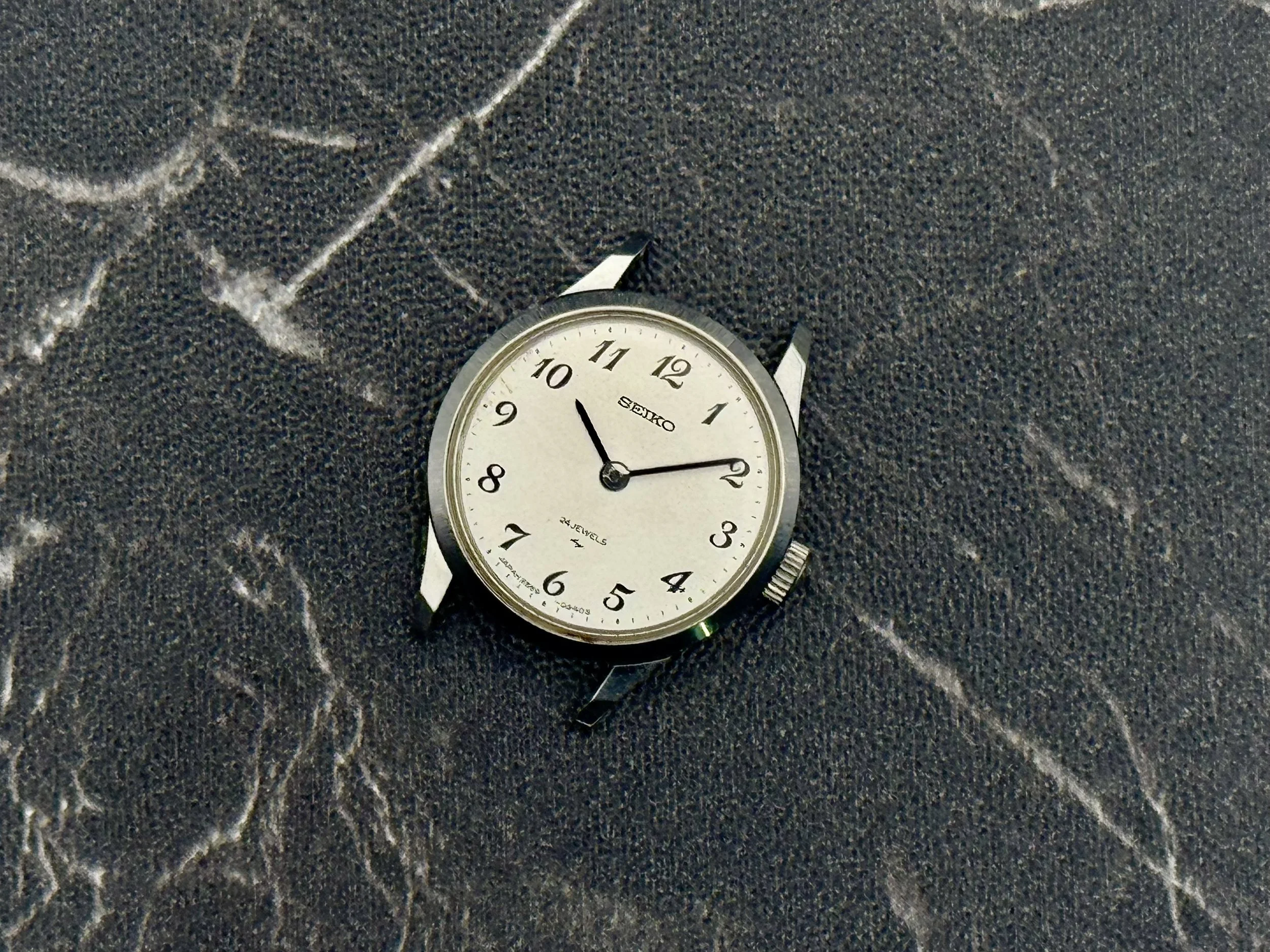
Pictured above: 2559-0020 (what I am deeming the “Queen Bee”) from October 1969.
As far as I've been able to determine, none of the watches that used the 2559 movement were ever marketed by Seiko formally as "Chariots," but given that the design language from this family of watches shows clear inspiration and lineage for what is to follow, I'd argue the 2559 family deserves to be considered the first Chariot-family watches, even if informally so. And given the 2559 movement was originally designed for ladies' watches, I'll go ahead and dub the 2559-0020 the "Queen Bee" of the family, for all intents and purposes. Seiko never announced this as a strategic pivot; the more accurate story is that a small, well-made ladies' caliber found a second life in men's and unisex dress cases, driven by a preference for smaller watches among many Asian male buyers at the time. This wasn't a budget proposition either, at least not at the top end. Gold-cased 2559 "Special Luxury" watches (not Chariots) sold for 140,000 to 280,000 yen in the late 1960s, pricing that sat right alongside (and by 1970, above) an 18-karat Grand Seiko.
Unpacking the 2559 (1968 to 1978)
Let's unpack the 2559 in a few different clusters:
Pocket watches. I happen to be a huge collector of pocket watches outside of Seiko Chariots. Now that I've seen there are pocket watches from 1968 carrying the 2559 movement, I'm starting to think about adding a few of these to my collection. There's not a ton out there on these watches, but by 1968, pocket watches were already a declining format, so putting a cutting-edge hi-beat movement into one is incredibly special. Reference 2559-0160 is the best-documented of the bunch, sold by one specialist dealer explicitly as a hi-beat pocket watch. My favorite of the group is the 2559-0140, but that one's a single forum-sourced lead so far. I have not actually seen one for sale like some of the other pocket watch references. My hope is that I come across one soon (eBay alerts set!). I don't yet have a confident case-size range for this cluster specifically, something to nail down as more examples surface. Example References (Non-Exhaustive): 2559-0160, 2559-0140, 2559-0150, 2559-0170.
Round dress watches. The 2559-0180 and the 2559-0181 are the strongest documented cluster from the 2559 series that I've been able to find. My 2559-0180 measures 33.3mm in diameter, is very slim, and genuinely wearable. Many of the examples came with a basket-weave linen or standard linen dial. That texture on the dial wasn't a Chariot invention, for what it's worth. It was an era-wide trend across both Swiss and Japanese dress watches in this period, an economic, elegant way to add visual interest to an otherwise plain two-hand dial. And that "24 JEWELS" printed on the dial wasn't just showing off, either: printing jewel counts was standard industry practice at the time (in 1974 this habit was cracked down on due to an international standard that was aimed at brands padding movements with purely decorative, non-functional jewels for bragging rights). The 2559's 24 are all legitimate. It also carries a micro-regulator, a fine-adjustment mechanism that lets a watchmaker dial in the rate far more precisely than a standard index lever. These two references appear to be the precursor and inspiration for the 2220-0180 (a reference from the first formally named Seiko Chariot in the catalogs), a watch that we'll revisit later. Example References (Non-Exhaustive): 2559-0020 (see "Queen Bee" above), 2559-0180, 2559-0181, 2559-0060.
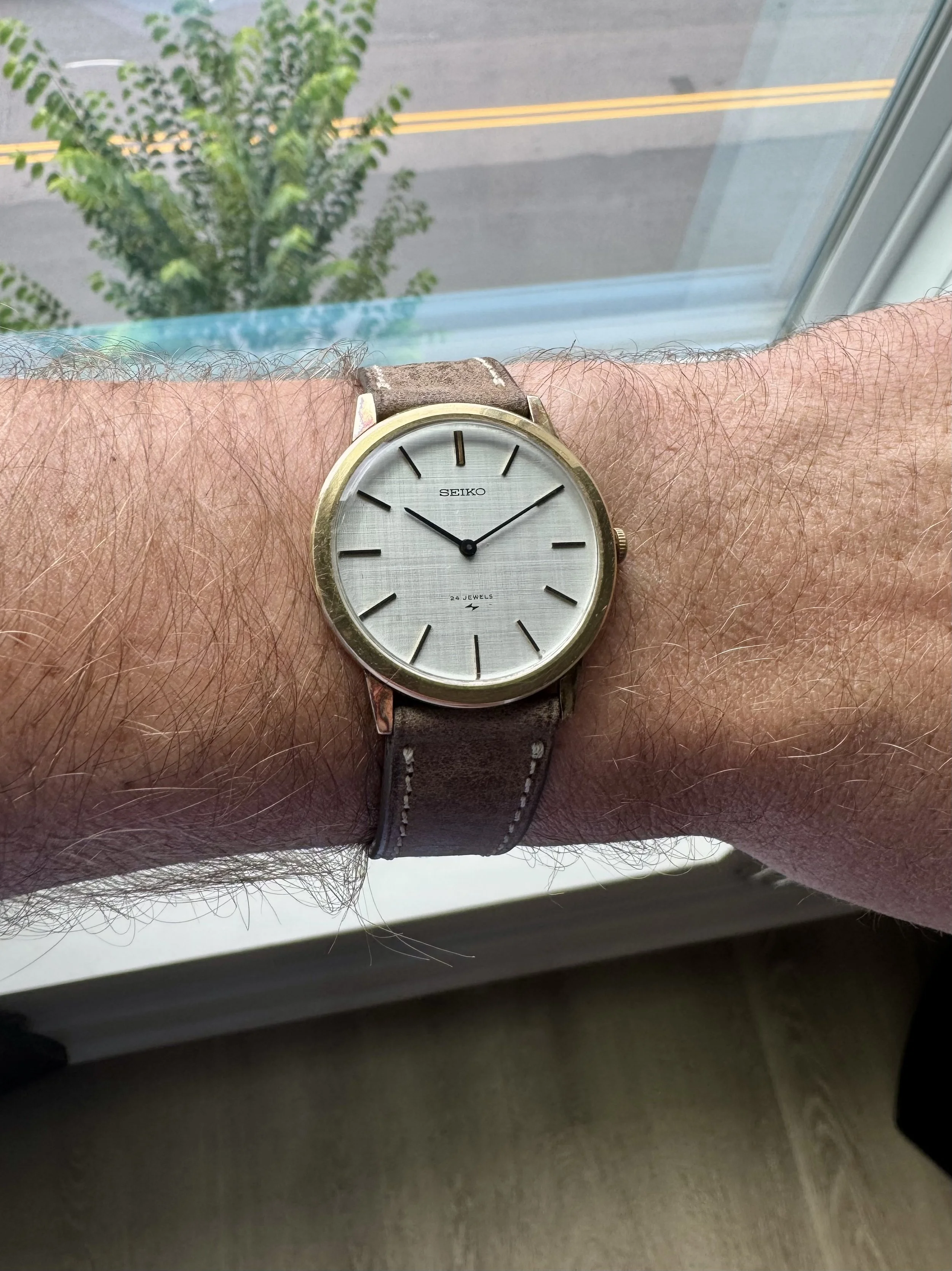
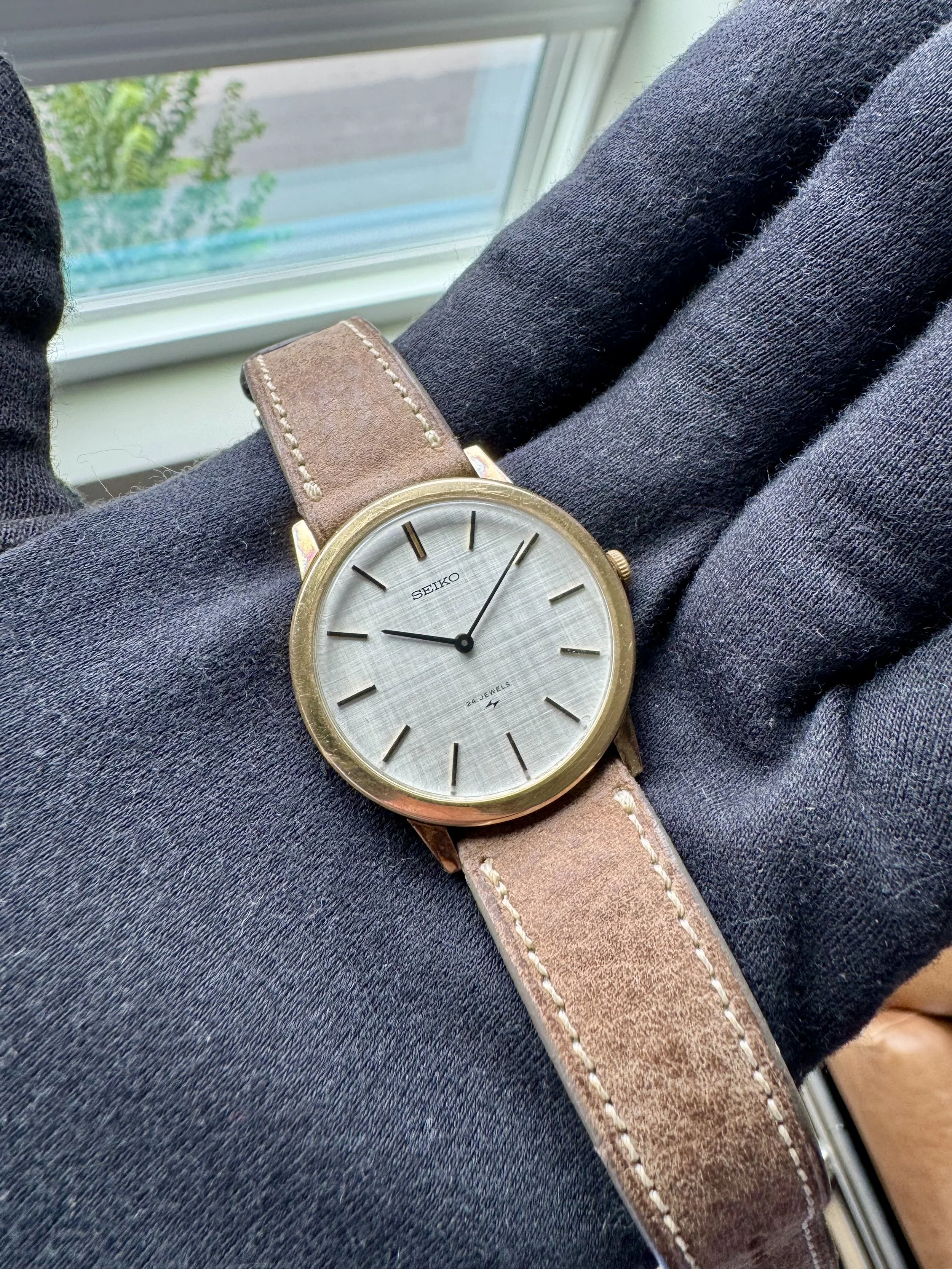
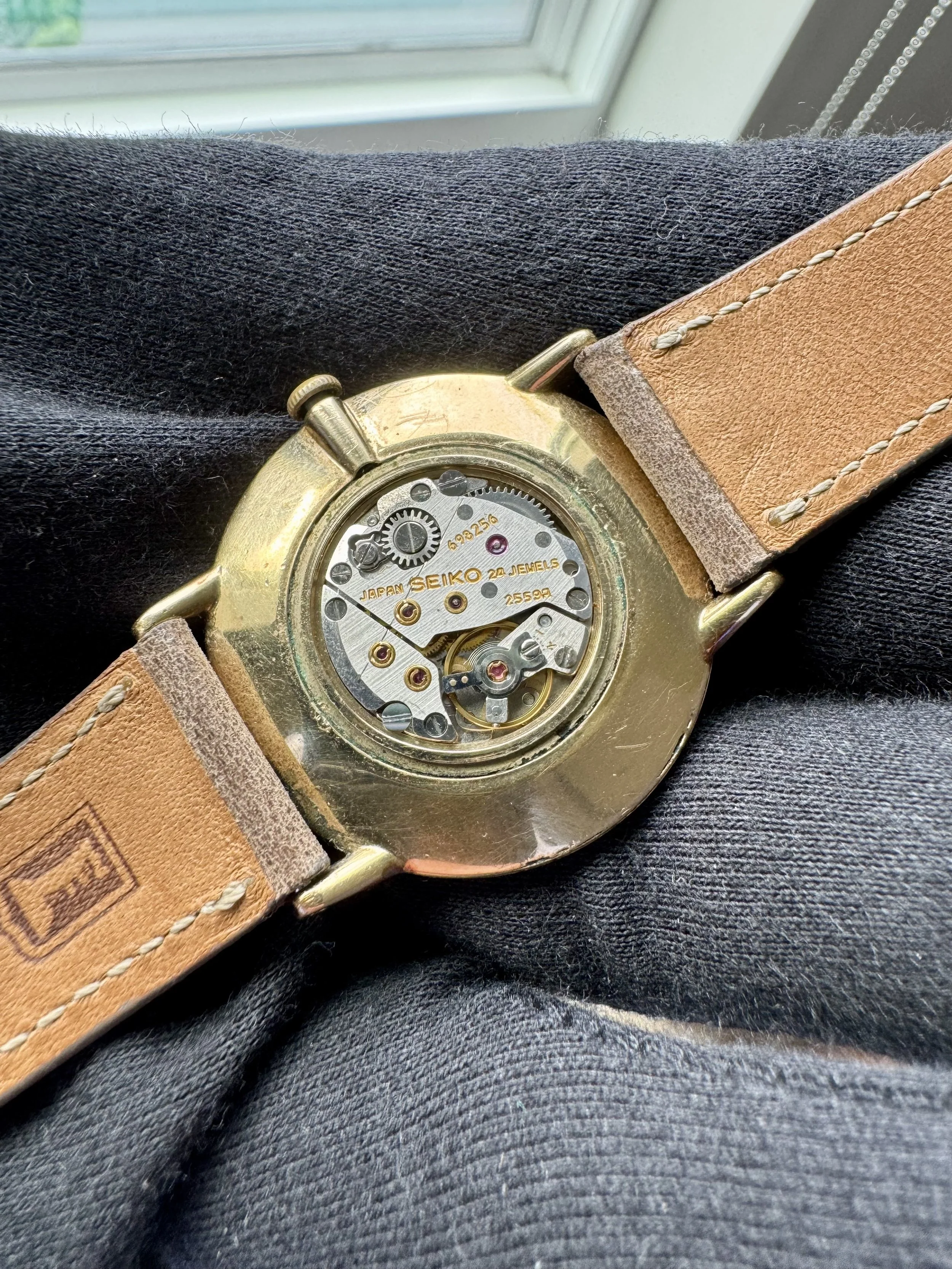
Pictured above: 2559-0180 in gold-tone case with silver linen dial from March 1971.
Tank/square watches. Several square watches came out of the 2559 family. The 2559-3010/3019 is probably the reference you'll see most out there. The two reference numbers likely represent different export markets for essentially the same watch, a numbering pattern Seiko used elsewhere in this era. For this reference, there are multiple dial colors (silver and blue) and dial configurations (horizontal indices and crosshair dials). This reference is incredibly wearable, with a 29.5mm x 29.5mm case that wears larger than the dimensions suggest and fits comfortably on most wrists. In many cases, you can find these on their original mesh bracelets, which hold up to the general reputation mesh bracelets have for comfort in this era, a nice change of pace, since vintage Seiko bracelets don't always get the same praise. A gold-tone version can also be found: reference 2559-3189. Example References (Non-Exhaustive): 2559-3010, 2559-3019, 2559-3189, 2559-3030, 2559-7000, 2559-7020.
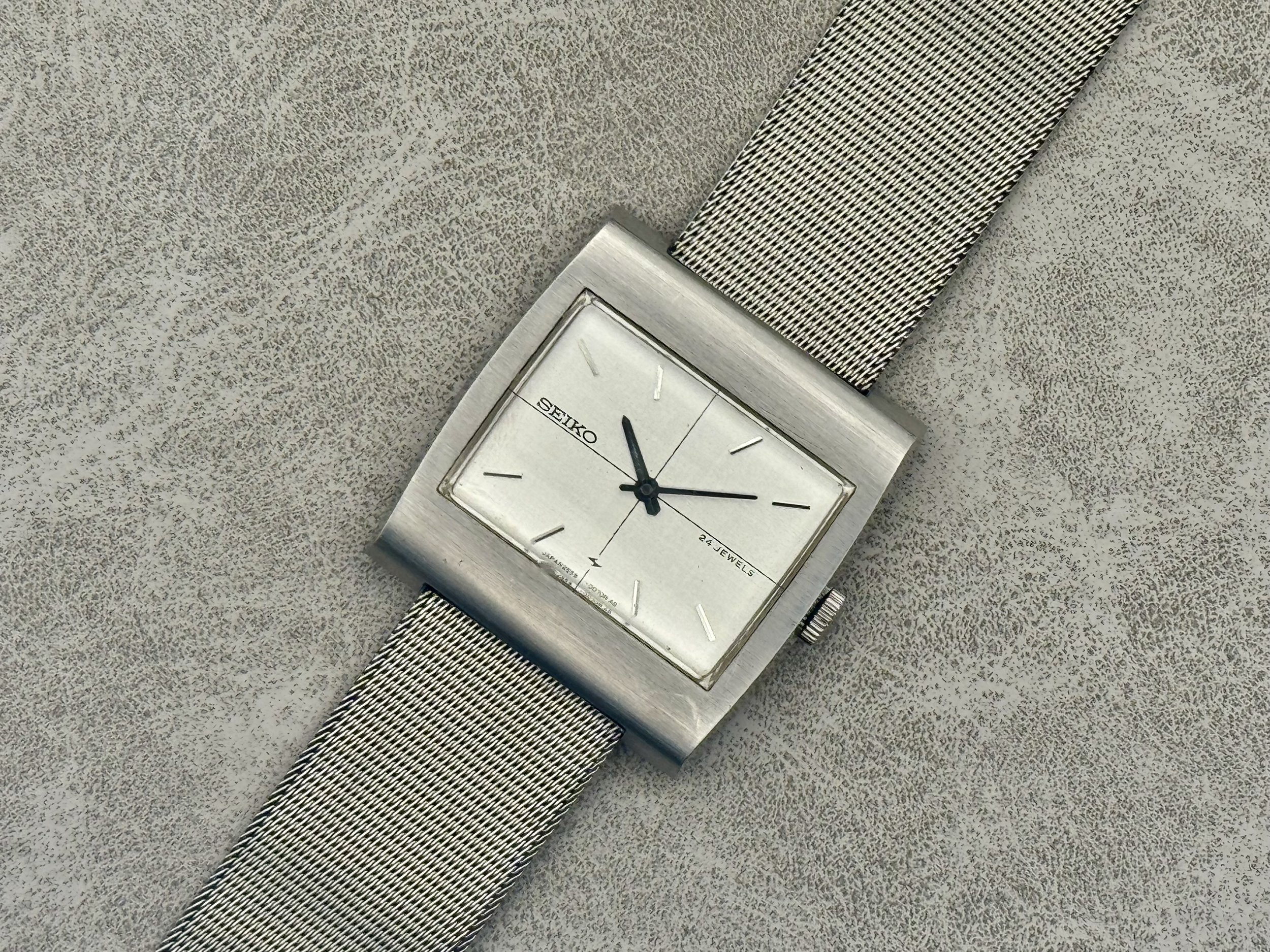
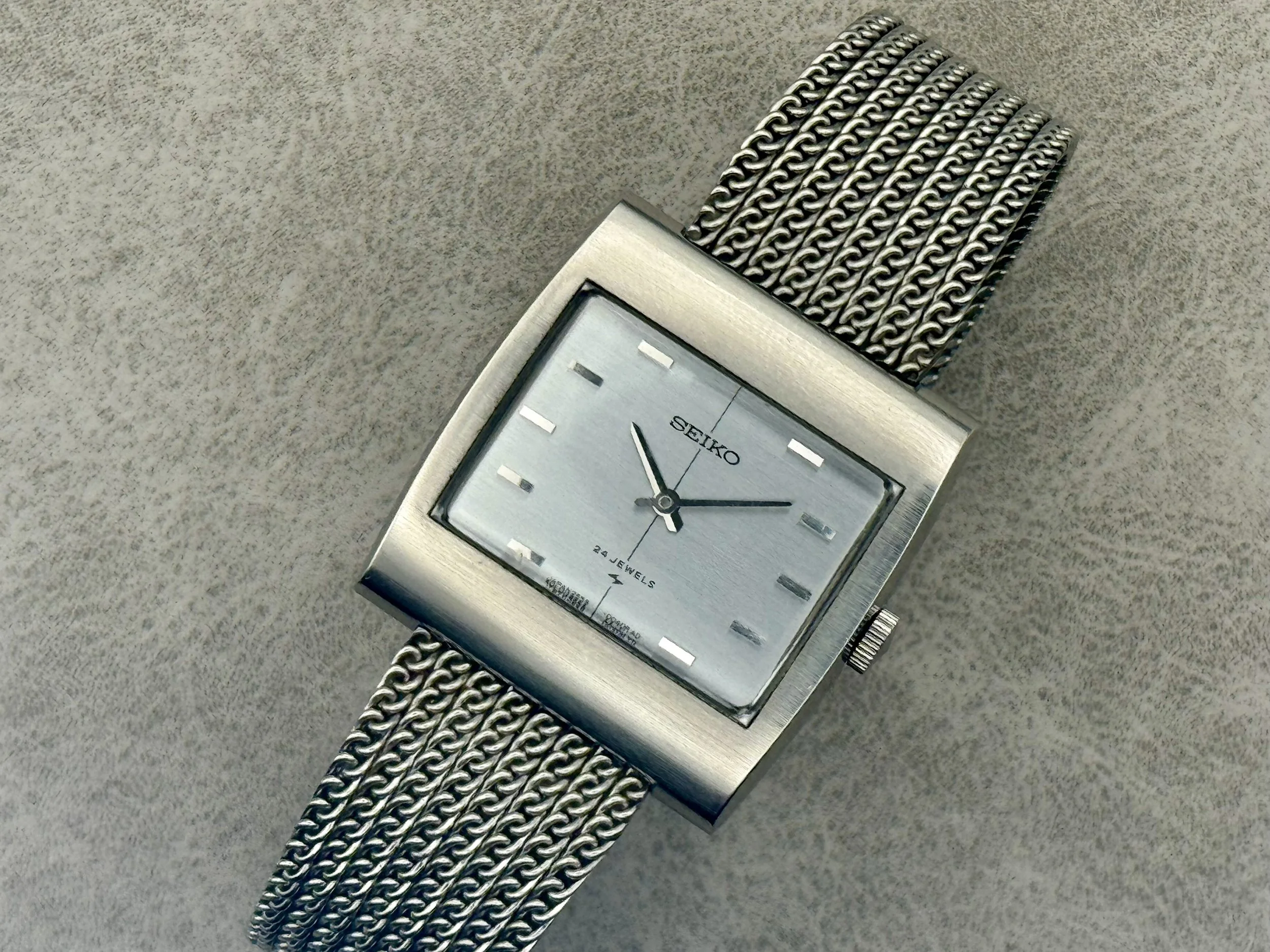
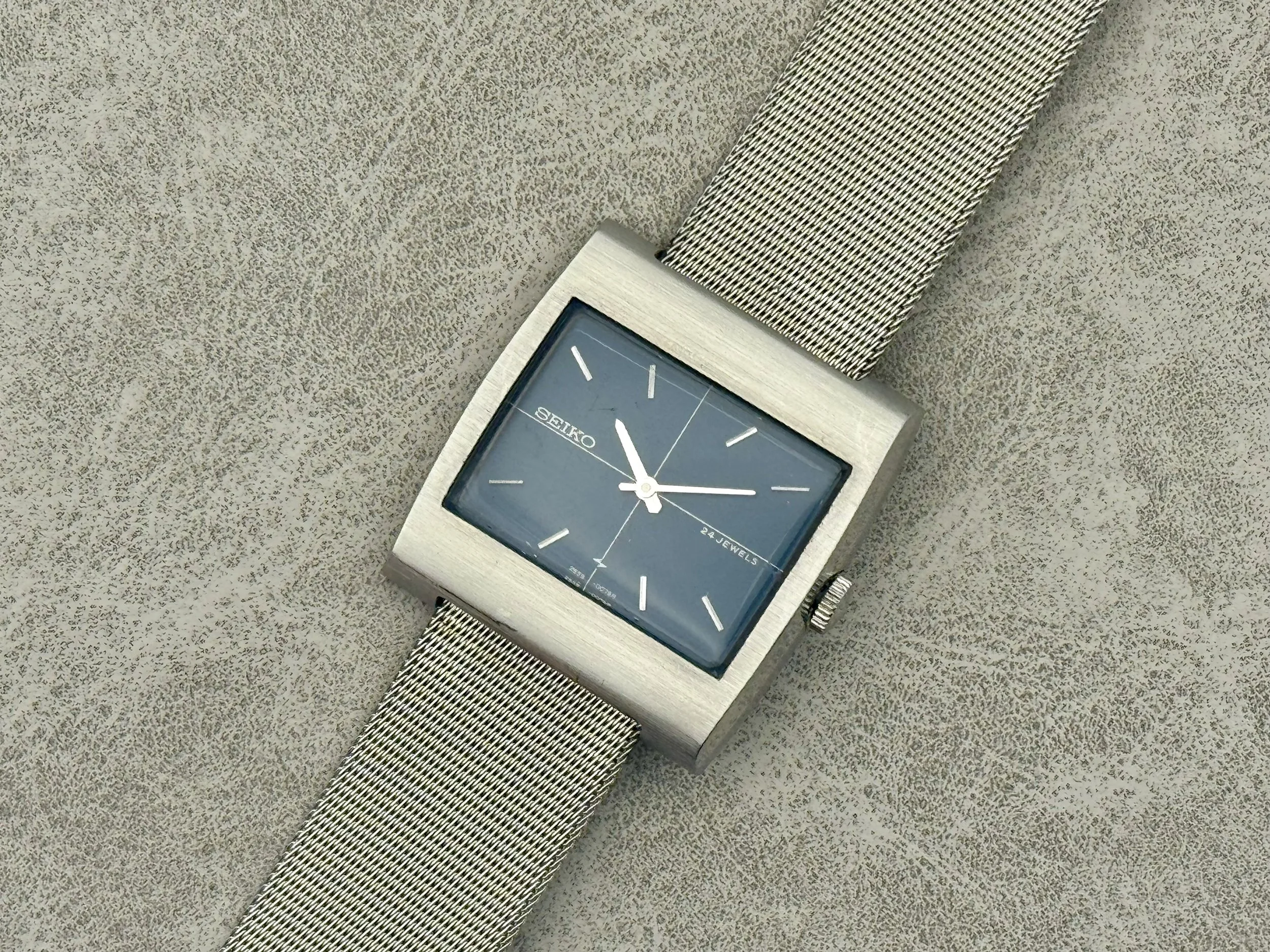
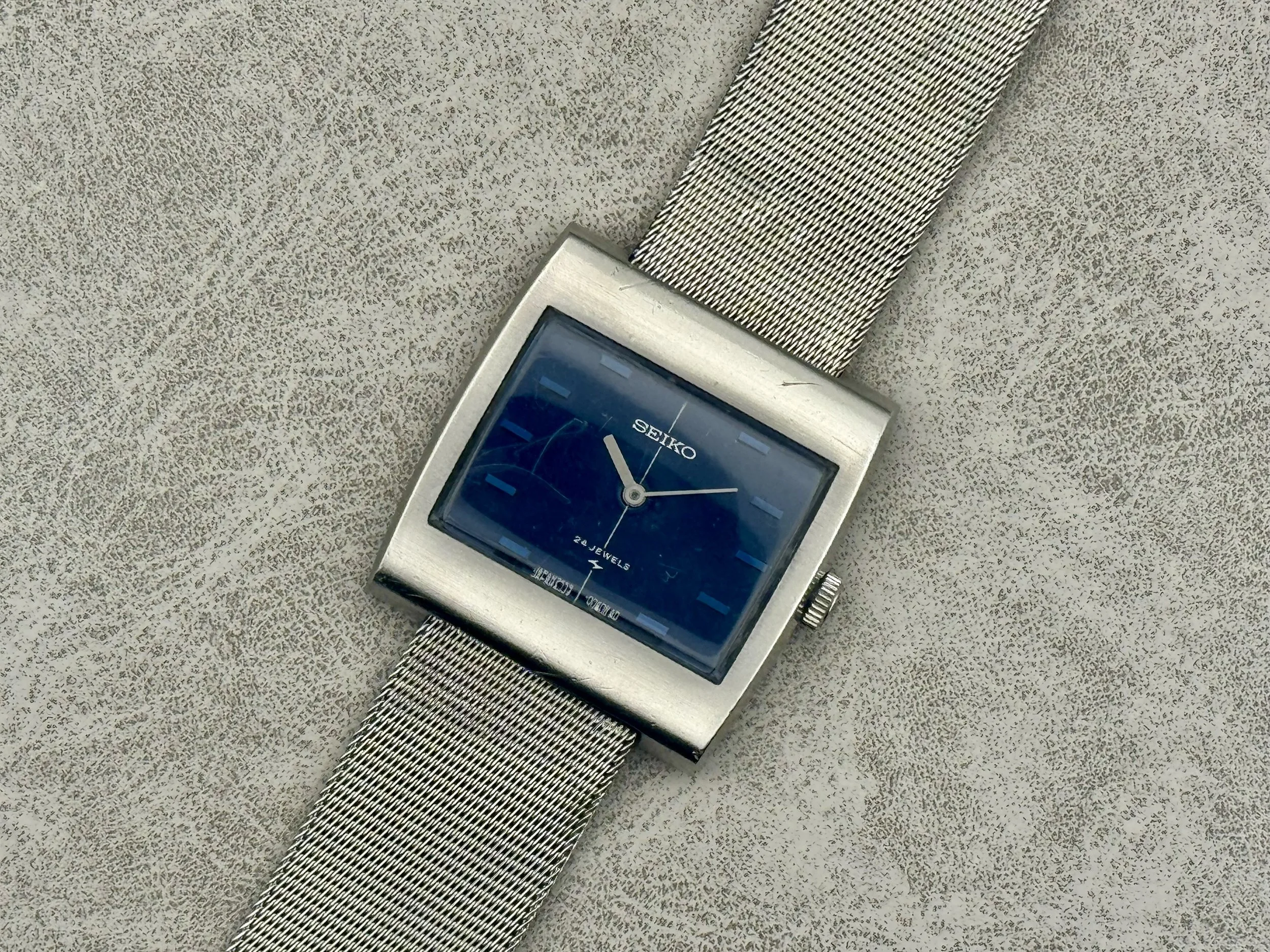
Pictured above left to right: Ref. 2559-3010 with silver crosshair dial from January 1971, Ref. 2559-3010 with silver dial and horizontal Indices from April 1969, Ref. 2559-3019 with blue crosshair dial from May 1971, Ref. 2559-3010 with blue dial and horizontal indices from May 1970. All pictured on original bracelets with the exception of the silver dial with horizontal index dial. Blue dial with horizontal indices variant may have service replacement minute hand.
Elongated tank and tonneau watches. The elongated, curved cases in this cluster are Seiko's best attempt at creating a watch for the Jeffersons, futuristic and minimalist at the same time. Seiko was also trying to capitalize on a trend in the industry at the time, as cushion and tonneau cases were having a real moment in the early 1970s, reportedly claiming something like a quarter of the market at their peak. I own the 2559-7019 in both blue and a marbled red (perhaps a limited edition - not yet confirmed) myself. I'm a huge fan of these, as the curved case makes them incredibly comfortable on the wrist. This archetype will also turn out to be the precursor to some references that come later down the line. Collectors may also opt for the 2559-3020, with a tonneau case and horizontal indices on the dial. Example References (Non-Exhaustive): 2559-7019, 2559-3020, 2559-7010, 2559-7040, 2559-7050.
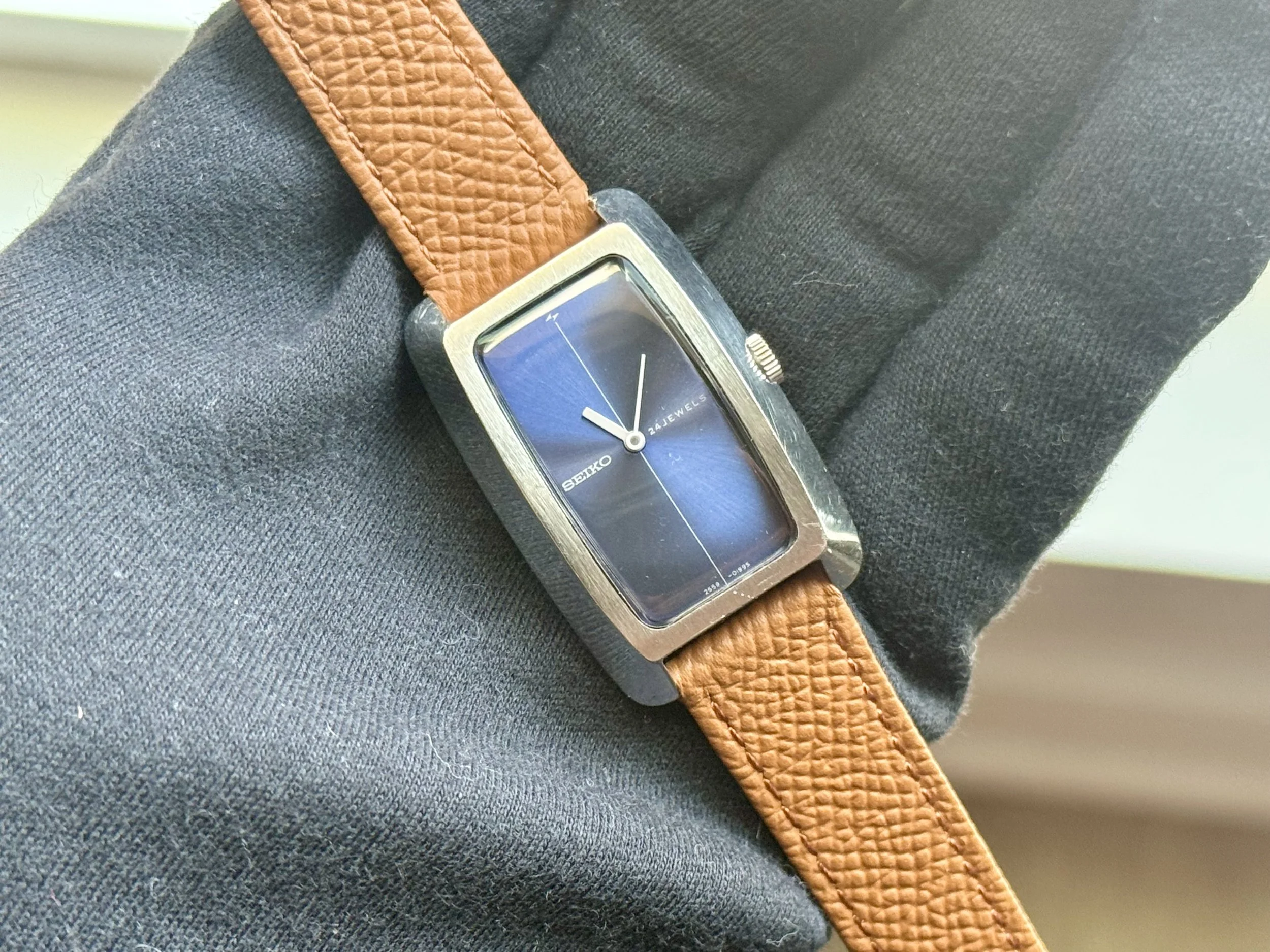
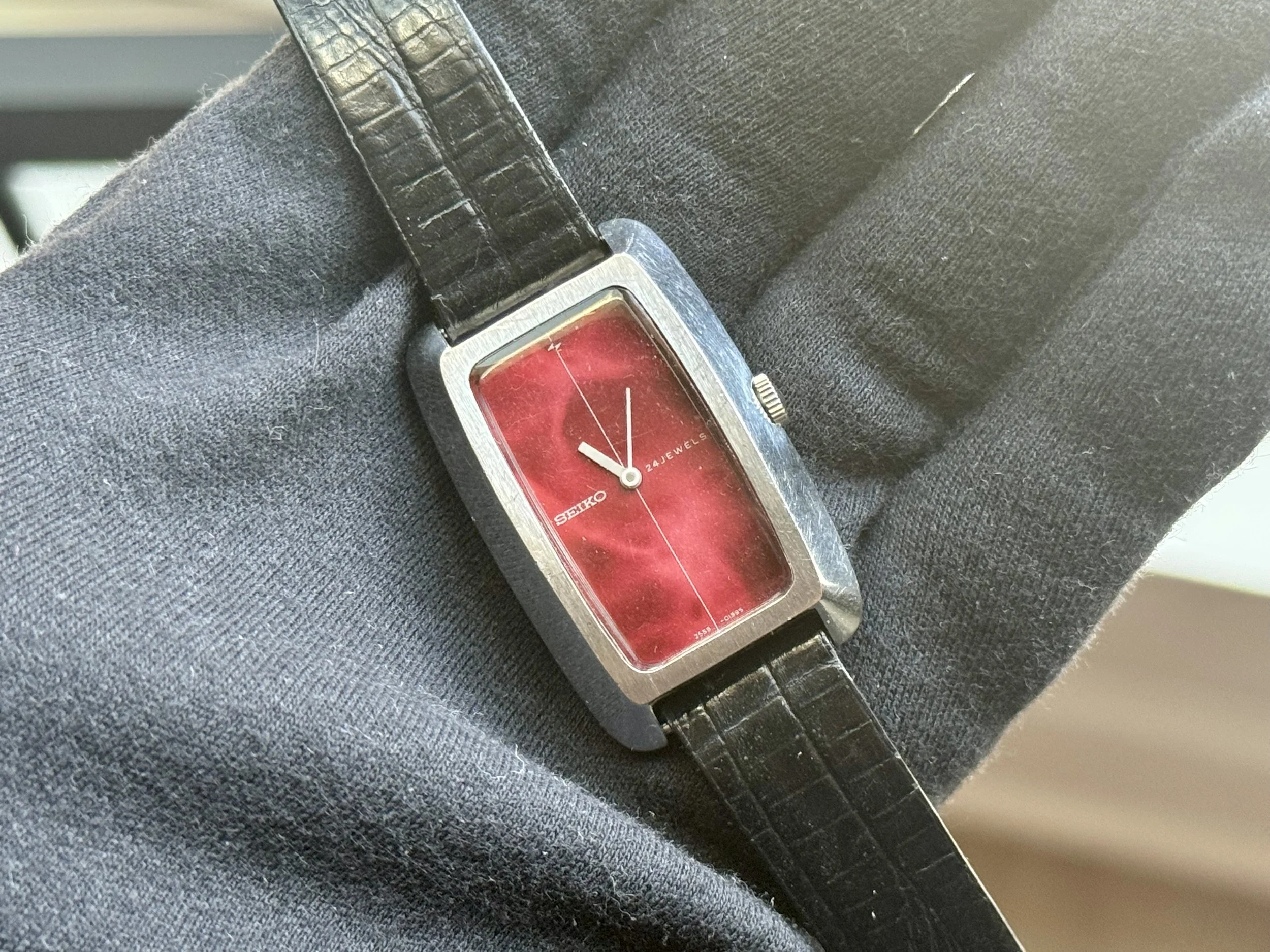
Pictured above: Two 2559-7019 elongated, curved tank watches - one with standard blue sunburst dial from July 1971 and the other in rare marbled red variant from June 1971 (could potentially be a limited edition, as these are much harder to find).
A practical note if you're thinking about actually wearing one of these instead of just admiring it (also acceptable): hi-beat movements like the 2559 generally require shorter service intervals than a standard-beat vintage watch, and collectors report that these movements don't respond well to over-oiling. And while that’s true, parts availability for a 55-plus-year-old ladies-derived caliber is likely the biggest obstacle here. That shouldn’t be a reason not to get into collecting these watches though; there are plenty in excellent vintage condition.
Across all of these different case shapes and sizes, a few threads stay consistent:
The hi-beat movement itself.
The dial signature: "24 JEWELS" printed on the dial along with the Daini lightning-bolt logo shows up across the whole range, and a lot of the dials share a design language too: deep blues, silvers, horizontal indices, crosshair patterns, etc.
Slimness and wearability as a through-line, prioritizing comfort and an elegant dress-watch silhouette.
The real departure across these watches is the case shape. That's where Seiko chose to experiment.
An identity had been formed and cohesion had been created before the collection ever had a name. I'd argue everything that eventually got formally branded as Chariot carries this same DNA as a continuation of the original design language. And that design language didn't disappear right as the 2220 came along, either. The 2559 carried on for years alongside the newer movement, before "Chariot" ever appeared in a Seiko catalog. That overlap, and the shared design philosophy, is probably why collectors retroactively have assigned the Chariot name to this 2559 family of watches.
These weren't the cheap option either. Not at the top end, anyway. The Seiko 36,000 bph flagship 45GS and 45KS were being built at the same time. The obsession with beat rate and fine adjustment that defined Seiko's actual prestige line in this era runs straight through the 2559 too, even though it was never chronometer-graded. There was a real trend toward small, slim dress watches at the time, and Seiko was clearly responding to it. But that's about as far as the influence goes. Seiko wasn’t chasing a rival or copying a Swiss house's design; the 2559 family isn't derivative of anything in particular. That's part of why the Chariot design language became so compelling: it's Seiko working within a real “box”, but on its own terms. And perhaps there was a bit of luck (and practicality) involved that the 2559 was an immediate plug-in.
From here, the story moves to the 2220, the movement that inherited this identity, and the one that would finally get to call itself Chariot.
Appendix: 2559-Series Watches Identified in This Guide (Non-Exhaustive)
| Reference | Cluster | Details / Design Elements / Variants | Approx. Case Size(s) |
|---|---|---|---|
| 2559-0020 | Round dress watch | Round case; understated ladies' dress watch. Dial variants: standard dial, plus a Breguet-numeral variant that appears unique within the 2559 family. | 21.5mm |
| 2559-0060 | Round dress watch | Round case with faceted/winged lugs, in steel and gold-tone. Dial variants: basket-weave linen. | 33mm |
| 2559-0140 | Pocket watch | Pocket watch with a uniquely faceted crystal. Dial variants: black dial. Note: I have never seen one of these for sale. | Not yet confirmed (appears similar in size to 2559-0150) |
| 2559-0150 | Pocket watch | Minimalist, architectural pocket watch in steel. Dial variants: linen. | 30mm |
| 2559-0160 | Pocket watch | Minimalist pocket watch with a hammered case finish, in steel and gold-tone. Dial variants: sunburst dials with Arabic numerals, in black/silver (steel) and champagne (gold-tone). | 36mm |
| 2559-0170 | Pocket watch | Minimalist pocket watch with a hammered case finish, in steel and gold-tone. Dial variants: linen dials with Roman numerals, in silver, champagne, and black. | 36mm |
| 2559-0180 | Round dress watch | Round case, in steel and gold-tone. Dial variants: standard linen with stick indices, or basket-weave linen with Roman numeral indices. | 33mm |
| 2559-0181 | Round dress watch | Essentially the same watch as the 2559-0180. Note: my leading hypothesis is that this represents a minor case revision rather than a distinct design. | 33mm |
| 2559-3010 | Tank/square watch | Square case, typically found on a mesh bracelet. Dial variants: crosshair dials with stick indices (silver, blue), and single-vertical-line dials with horizontal indices. | 29.5mm x 29.5mm |
| 2559-3019 | Tank/square watch | Essentially the same watch as the 2559-3010. Note: my leading hypothesis is that 3010/3019 represent different export markets for the same design. | 29.5mm x 29.5mm |
| 2559-3020 | Elongated tank/tonneau watch | Tonneau-style case. Dial variants: the only example I've seen has a blue dial with horizontal indices and a "diamond" marker at 12. Note: likely also sold as a ladies' model. | 25mm |
| 2559-3189 | Tank/square watch | Appears to be the same watch as the 2559-3010/3019, in a gold-tone case. Dial variants: gold crosshair dial. | 29.5mm x 29.5mm |
| 2559-7000 | Tank/square watch | Rounded-square case with softened corners and a thick bezel. Dial variants: crosshair dials and stick-index dials with Roman numerals at 3/6/9/12, in silver, blue, and black. | Not yet confirmed (~30-32mm x ~30-32mm) |
| 2559-7010 | Elongated tank/tonneau watch | Narrow, elongated rectangular tank case with a curved profile. Dial variants: primarily blue, with a vertical center line. | 25mm x 38.3mm |
| 2559-7019 | Elongated tank/tonneau watch | Essentially the same watch as the 2559-7010. Note: my leading hypothesis is that 7010/7019 represent different export markets. I've also tracked down a rare marbled red dial variant for my own collection, unclear whether this was a limited edition. | 25mm x 38.3mm |
| 2559-7020 | Tank/square watch | Wide, compact rectangular tank case with thick case sides. Dial variants: horizontal indices. Note: still looking to find a good-condition example. | Not yet confirmed |
| 2559-7040 | Elongated tank/tonneau watch | Elongated tank case with a curved, lugless, block-like profile. Dial variants: navy dial with stick indices. | 26mm x 37mm |
| 2559-7050 | Elongated tank/tonneau watch | Similar case to the 2559-7000. Dial variants: silver and black dials with Roman numeral indices. | Not yet confirmed (~30-32mm x ~30-32mm) |